
Ingesting documents
Ingestion is how runic.rag turns raw text into a knowledge graph. Each document is chunked, the chunks are mined for entities and relations, those entities are deduplicated against what is already in the graph, and the whole result is written as one unit of work. Every write is an idempotent MERGE, so re-ingesting the same text never creates duplicates and shared entities collapse onto one canonical node — even across documents.
This page covers the pipeline, the two ingest verbs (ingest_text() vs ingest_document()), building one graph from many documents, loading bounded PDF page ranges, and the cost/performance knobs that keep large runs affordable.
The ingestion pipeline
ingest_text() and ingest_document() both run the same four-stage write pipeline. Stages 1–3 fan out and are cached/budgeted; stage 4 commits everything in a single writer transaction.
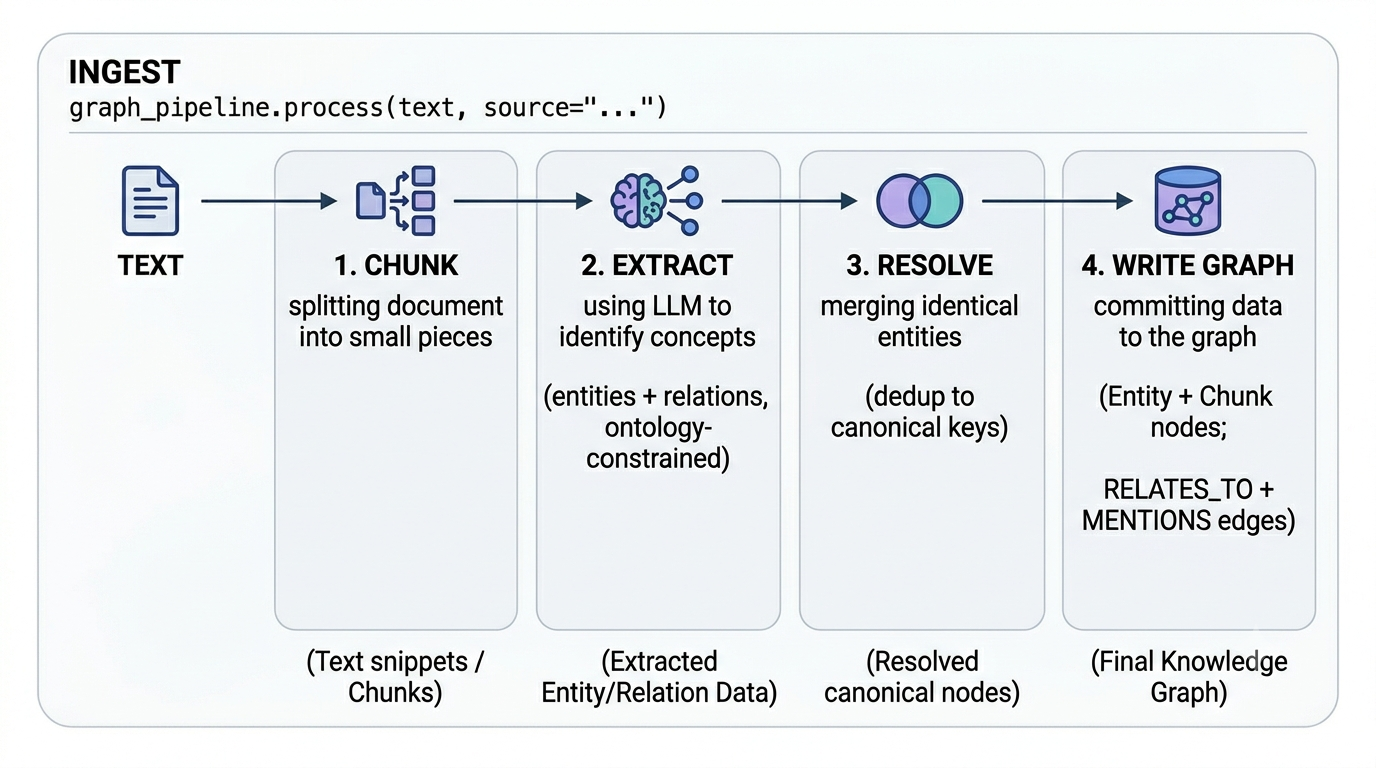
- Chunk. The text is split into overlapping paragraphs (
chunk_size/chunk_overlap). Each chunk keeps itssourcetag and a sequence number. - Extract. Every chunk is sent to the LLM in parallel to extract entities and relations, constrained to the ontology's entity types. Chunk texts are then embedded in one batched pass.
- Resolve. Each extracted entity is mapped to a canonical key — a deterministic key plus vector dedup against the store — so surface variants ("Ada Lovelace", "Lovelace") collapse onto one node.
- Write. Inside one
GraphStore.writer()transaction the service writesChunknodes (with embeddings), upsertsEntitynodes, createsRELATES_TOedges between entities, and recordsChunk-[:MENTIONS]->Entityprovenance. Every statement is aMERGE, which is what makes ingestion idempotent.
The MENTIONS edge is the provenance backbone: it records which chunk (and therefore which source) mentioned each entity, so an answer can cite the original document even after entities have been merged. See concepts for why the graph is built this way, and ontologies for tuning what the extractor pulls out.
INFO
The vector index used during extraction and dedup is created by bootstrap_schema(), which is idempotent. Call it once on startup before your first ingest — it raises ValueError if embedding_dim <= 0.
ingest_text vs ingest_document
Use ingest_text() for strings you already hold in memory; use ingest_document() to load a file from disk.
ingest_text(text, *, source) ingests a raw string. The source keyword is required — it is the provenance tag that ends up on every chunk and in every citation, so make it meaningful.
from runic.rag import GraphRAG, Ontology, RagSettings

rag = GraphRAG.with_defaults(settings=RagSettings())
rag.bootstrap_schema()

report = rag.ingest_text(
    "Ada Lovelace worked with Charles Babbage on the Analytical Engine.",
    source="inline-demo",
)
print(
    f"Ingested: {report.chunks} chunks, {report.entities} entities, "
    f"{report.relations} relations, {report.mentions} mentions"
)ingest_document(path) loads a file and dispatches by extension before running the same pipeline. source is set to the string form of path.
| Extension | Loader |
|---|---|
.pdf | documents.load_pdf |
.md / .markdown | documents.load_markdown |
| anything else | documents.load_text |
report = rag.ingest_document("docs/whitepaper.pdf")TIP
For structure-aware parsing — complex PDFs, tables, scanned pages, or Office formats — the optional Docling add-on implements the file-oriented DocumentParser / DocumentChunker ports and plugs straight into ingest_document(), while the core stays dependency-light for plain text.
Both verbs return an IngestionReport — a frozen value object with the counts written this run:
| Field | Meaning |
|---|---|
chunks | Chunk nodes persisted |
entities | distinct entities upserted (after resolution) |
relations | RELATES_TO edges created |
mentions | Chunk-[:MENTIONS]->Entity provenance edges |
Because every write is a MERGE, the report counts distinct graph elements, not raw operations. Re-ingesting identical text yields identical counts and adds nothing to the graph.
INFO
with_defaults(settings=...) is the driverless form: it builds a FalkorDB driver on localhost:6379 from settings.backend. To target a different backend or an existing driver, see configuration.
Ingesting multiple documents
To build one graph from several documents, call ingest_text() once per document with a distinct source. Entities that recur across documents MERGE onto a single canonical node (entity resolution); their mentions stay attributed to the document each came from. This is what separates a graph RAG from a flat vector store.
CORPUS: dict[str, str] = {
    "lovelace_biography.txt": DOC_BIOGRAPHY,
    "analytical_engine.txt": DOC_MACHINE,
    "lovelace_legacy.txt": DOC_LEGACY,
    "modern_pioneers.txt": DOC_MODERN,
}

for source, text in CORPUS.items():
    report = rag.ingest_text(text, source=source)
    print(
        f"  {source:<24} "
        f"chunks={report.chunks}  entities={report.entities}  "
        f"relations={report.relations}  mentions={report.mentions}"
)To prove the dedup worked, inspect answer.context after a query. The retrieval context exposes the canonical entities behind the answer: an entity reached from several documents appears exactly once in context.entities, while the citations span multiple sources.
answer = rag.query(
    "How is Ada Lovelace connected to the Analytical Engine and Alan Turing?",
    mode="hybrid",
)

# Each canonical entity shows up once, no matter how many docs mentioned it.
context = answer.context
if context is not None:
    for entity in context.entities:
        print(
            f"  - {entity.name} ({entity.type}) "
            f"key={entity.canonical_key} score={entity.score:.4f}"
        )

# Provenance lives on the citations, which span the source documents.
sources_seen = {citation.source for citation in answer.citations}
print(f"distinct sources cited: {len(sources_seen)} of {len(CORPUS)}")Each EntityHit carries name, type, canonical_key, description, and a score; RelationHit exposes source_key, target_key, rel_type, and description for the edges traversed in the graph. Always guard answer.context for None — it is populated on retrieval but may be absent.
INFO
The full runnable version is examples/rag/03_multiple_documents.py.
Loading PDFs
For text/Markdown/PDF on disk, ingest_document() is the one-liner. When you need a bounded slice of a large PDF — to keep a run cheap or to ingest one section — use the loaders in runic.rag.adapters.documents directly and feed the text to ingest_text().
from runic.rag.adapters import documents

# 1-based, inclusive page range; out-of-range bounds are clamped to the doc.
pages = documents.load_pdf_pages(
    "BusinessMagazin.pdf", first_page=1, last_page=8
)
text = "\n\n".join(page_text for _, page_text in pages)

report = rag.ingest_text(text, source="manager-magazin:pages-1-8")load_pdf_pages(path, *, first_page=None, last_page=None) returns a list[tuple[int, str]] of (page_number, text) pairs, page numbers 1-based, so you can report or process pages individually. first_page / last_page are 1-based and inclusive; None means "from the start" / "to the end".
To load an entire PDF as one string, use load_pdf(path):
text = documents.load_pdf("BusinessMagazin.pdf")
report = rag.ingest_text(text, source="manager-magazin:all-pages")INFO
The flagship PDF walkthrough is examples/rag/04_manager_magazin_pdf.py, which ingests the same slice under two ontologies and compares the results.
Controlling cost & performance
Ingestion calls the LLM once per chunk and the embedder in batches, so a large corpus can be expensive. RagSettings exposes four levers. Override them on a loaded settings object with model_copy, then pass it to with_defaults:
from runic.rag import GraphRAG, load_settings

settings = load_settings().model_copy(
    update={
        "max_llm_calls": 300,   # hard cap on LLM calls (0 = unlimited)
        "max_tokens": 0,        # hard cap on estimated tokens (0 = unlimited)
        "embed_batch_size": 128,
        "concurrency": 8,
        "requests_per_minute": 0,
        "cache_dir": ".cache/runic-rag",
    }
)
rag = GraphRAG.with_defaults(settings=settings)BudgetGuard (max_llm_calls / max_tokens). A hard ceiling on spend. with_defaults builds one shared BudgetGuard that spans ingestion and the query path, so the caps cover the whole run rather than each component in isolation. The guard checks before each request and records usage only after a call succeeds (so failed calls cost nothing); exceeding a limit raises BudgetExceededError. 0 means unlimited. Tokens are a tiktoken estimate, not a provider's billed usage.
Content cache (cache_dir). Extractions and embeddings are memoised in a content-addressed cache keyed by content hash. Re-ingesting unchanged text — or a corpus that overlaps a previous run — skips the LLM and embedder entirely. Point cache_dir at a persistent path to make re-ingestion nearly free.
Batched embeddings (embed_batch_size). Chunk and entity texts are embedded in one embed_batch request per group of embed_batch_size texts instead of one request per text, so a document with K distinct texts issues ceil(K / embed_batch_size) requests. Each batch counts as a single budget / rate-limit unit.
Concurrency & throttling (concurrency / requests_per_minute). Per-chunk extraction runs in parallel across concurrency workers. requests_per_minute rate-limits every LLM/embedder request (0 disables the limit) — raise concurrency for speed, set a rate limit to stay under a provider quota.
WARNING
A run that exceeds max_llm_calls or max_tokens raises BudgetExceededError mid-ingest. Set caps generously enough to cover the document, or leave them at 0 and rely on the cache to avoid repeat spend.
The full environment-variable table (RUNIC_RAG_*) lives in configuration.
Recommendations
TIP
- Tag a meaningful
sourceper document. It is what shows up in citations (Citation.source) and on everyMENTIONSedge — a stable, human-readable id pays off when you trace an answer back to its origin. - Cap cost on big PDFs. Set
max_llm_callsbefore ingesting a large document so a runaway extraction fails fast instead of draining your quota. - Make re-ingestion cheap. Set
RUNIC_RAG_CACHE_DIR(orcache_dir) to a persistent path; repeated and overlapping ingests then skip the LLM and embedder via the content cache. - Ingest related documents into ONE graph. Shared entities
MERGEonto a single canonical node, so cross-document questions traverse a connected graph instead of isolated islands.
Next steps
See also
- Retrieval & answers — how questions are answered, retrieval modes, and
answer.context - Document parsing with Docling — structure-aware parsing of complex PDFs, tables, and scans
- Designing & optimizing ontologies — tune what the extractor pulls out of each chunk
- Configuration & deployment — the full
RUNIC_RAG_*settings reference - API Reference —
IngestionReport,documents.load_pdf_pages, and the rest of the surface - examples/rag/03_multiple_documents.py — multi-document ingestion + dedup proof
- examples/rag/04_manager_magazin_pdf.py — bounded PDF ingestion with a cost budget